 US
THE SOLUTION · EXPLAINED LIKE YOU’RE TEN
Get the agents to turn up
Bring every AI helper into one room where everyone can see it, instead of letting it work out of sight.
First, what’s an agent?
An agent is a computer helper. You give it a job and it gets on with it. Some agents ask before they do anything. Some just do it. An autopilot is an agent that runs all by itself, often at night, while everyone is asleep.
So what’s the problem?
Most of these helpers are invisible. They work in the background. Nobody can see how many there are. Nobody is quite sure who looks after each one. Nobody knows exactly what they’re allowed to do. That’s how things go wrong without anyone noticing. (The problem page has the numbers.)
Our idea
Make the helpers turn up. Give them a place in a shared room, just like the people. When you can see them, you can check on them, learn from them and work with them.
Think of a classroom
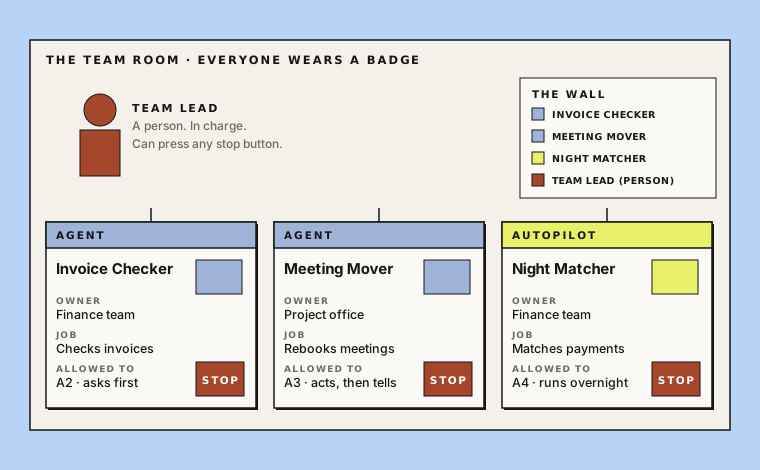
Imagine a classroom with a few helpers in it. Each helper wears a name badge. The badge says their name, which teacher they work for, what their job is, and what they’re allowed to do on their own. The teacher is always in charge, and can say “stop” at any time.
Now imagine the same helpers working in a cupboard with the door shut. They might be doing a great job. They might not. You’d never know. We want the classroom, not the cupboard.
Or think of a football team
Every player has a shirt with a number, a position and a coach. You can see who’s on the pitch. Agents should be the same: on the team sheet, in a position, with a coach.
WHAT THIS LOOKS LIKE IN FRAME
Each agent gets a spot in your organisation’s space
Frame is a 3D space that opens in a web browser or a headset. Your organisation gets its own space. Every agent and autopilot gets a spot in it, with an avatar or a board, and a badge that shows:
NAME
Who it is
A plain name, like “Invoice Checker”, not a code.
OWNER
Who looks after it
A real person or team. No owner, no badge, no job.
JOB
What it does
One sentence. If it needs a paragraph, it’s probably two agents.
ALLOWED TO
How much it does alone
Its level on the autonomy ladder, from A0 (just answers) to A4 (runs by itself).
STOP BUTTON
A human in charge
Who can pause it, and how. Every badge shows it.
THE WALL
Everyone in one place
A board in the entrance lists every person, agent and autopilot. If it isn’t on the wall, it shouldn’t be running.
WHY IT HELPS
Seeing them fixes the three bills
RISK
Fewer nasty surprises
When every agent has an owner and a stop button, someone notices when it does something odd, and can stop it.
COST
No mystery bills
When you can see every helper, you can spot the ones doing the same job twice, or nothing at all, and switch them off.
ENABLEMENT
People learn by watching
Seeing a good agent at work, next to the person who looks after it, is the quickest way to learn how to use one.
That’s it. Make them turn up. Then the framework gives you six habits for keeping it that way: name it, place it, bound it, meter it, teach it, share it.