 US
A MANIFESTO FOR WORKING WITH AUTOPILOTS, AGENTS & HUMANS
Us and Them
Agents are arriving faster than we can see them, pay for them, or learn to work with them.
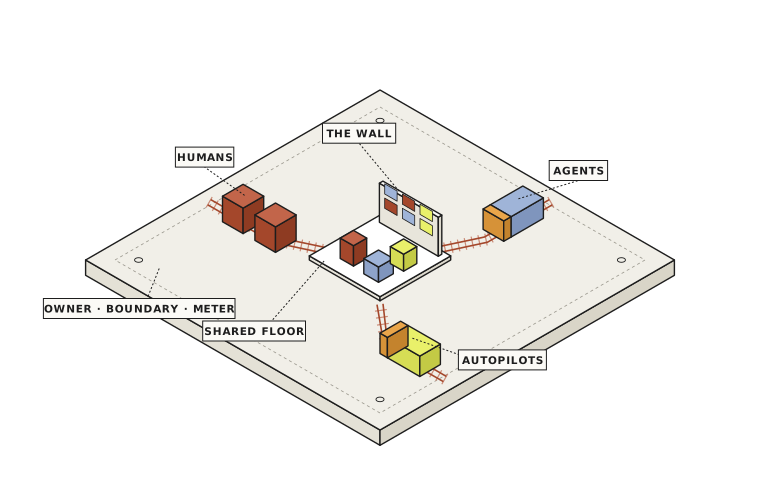
What if there was a better way of working together? One shared floor, where humans, agents and autopilots work in the open, under the same rules.
LAUNCH · THURSDAY 22 APRIL 2027
THE PROBLEM · WHEN AGENTS SCALE AND PEOPLE TRY TO CATCH UP
Three bills arrive when nobody’s watching
Left unchecked, the gap between how fast agents multiply and how fast people catch up turns into risk, cost and people left behind.
RISK
97%
of organisations that reported an AI-related breach lacked proper AI access controls.
IBM COST OF A DATA BREACH 2025 · SOURCE
COST
40%+
of agentic AI projects will be cancelled by the end of 2027 over cost, unclear value or weak risk controls, Gartner predicts.
GARTNER, JUNE 2025 · SOURCE
ENABLEMENT
36%
of employees say they’ve had enough AI training. Frontline regular use has stalled at 51%.
BCG AI AT WORK 2025 · SOURCE
THE SOLUTION · EXPLAINED SIMPLY
Get the agents to turn up
Right now most agents are invisible helpers working in the background. Our idea is simple: give every agent and autopilot a place in a shared room in FrameVR, wearing a name badge, so people can see who it is, who owns it, what it’s doing, and work alongside it like a colleague.
THE MANIFESTO · TWELVE LINES
What we believe
- There is no “them” without “us”.Every agent and autopilot exists because a person asked for it. A person stays answerable for it.
- If you can’t see it, you can’t trust it.Every agent has a name, a purpose, an owner and a place you can visit.
- Autonomy is earned, not assumed.Agents start by suggesting. They act alone only when they’ve shown they can, inside a boundary we’ve written down.
- Every agent has a meter.We know what it costs, what it saves and who sees the bill.
- Make it visible, then make it fast.Speed without visibility is how small mistakes become big ones.
- Learn together, in the open.Nobody should learn to work with agents alone in a chat window.
- Teach the people before you scale the agents.Enablement is the first budget line, not the last.
- Redesign the work, then add the AI.Don’t automate a broken process. Fix it, then hand the dull parts to the machines.
- Humans keep the judgement calls.Agents do the steps; people make the decisions that need values, context and care.
- Mistakes are shared, not hidden.When an agent gets it wrong, we say so, fix it and tell everyone what we learned.
- Retire what we don’t need.An agent nobody owns or uses gets switched off. Fewer, better agents beat many forgotten ones.
- We’re building this together.The manifesto is a living document. Anyone can propose a change.
THE FRAMEWORK · THE SHARED FLOOR
Name it. Place it. Bound it. Meter it. Teach it. Share it.
Six habits, an autonomy ladder from A0 (assist) to A4 (autopilot), clear roles and short rituals. Each habit fixes one part of the risk, cost and enablement problem.
HABIT 01
Name It
What is it, what is it for, and who owns it?
Every agent and autopilot is registered with a purpose, an owner, its data and its autonomy level. No owner, no launch.
HABIT 02
Place It
Where can I see it working?
Every agent appears in the organisation’s space: on the Wall, in its team’s zone, with its status.
HABIT 03
Bound It
What may it do on its own?
A written autonomy level (A0–A4), a data scope and the approval points.
HABIT 04
Meter It
What does it cost and what does it return?
A monthly budget, a usage view, an alert threshold and one value measure.
HABIT 05
Teach It
Do the people around it know how to work with it?
A learning path for builders, users and affected teams, with real hands-on hours.
HABIT 06
Share It
What have we learned?
A weekly show and tell, an open incident log and a monthly agent census, in the shared space.
ORGANISATIONAL SPACES · IN FRAMEVR
A place where the work can be seen
We build each organisation its own shared space in FrameVR, open in a browser or a headset. Six rooms, one for each habit. The team meets there, the agents are on the wall, and the boards update themselves.
THE BLOG · A YEAR OF LEARNING
Every Monday, one thing we learned
- Us and them: why we’re starting this
A year of learning in public about AI, agents and autopilots, and why the divide between people and machines is the real problem.
- Assistant, agent, autopilot: three words for three jobs
A plain-English way to tell them apart by how much they do without asking.
- Count your agents (you’ll be surprised)
How to run a first agent census in an afternoon, and what usually turns up.
- Who owns this agent?
The single question that fixes more problems than any policy. COMING SOON
- Shadow AI isn’t a crime, it’s a signal
Why people bring their own tools, and what that tells you about your rollout. COMING SOON
THE BOOK
Us and Them
A year of learning to work with Autopilots, Agents & Humans.
Twelve chapters, one for each month. Early-access edition at the launch; the complete edition in November 2027.
THE LAUNCH · OPEN FLOOR
Thursday 22 April 2027
12:30–14:00 BST, in the Us and Them space in FrameVR.
The website, the book, the templates and the spaces, launched on a floor you can walk around.
STAY IN TOUCH